
The Gloucester County Surrogate's Court
The Surrogate's Court sits at 17 North Broad Street in Woodbury. Giuseppe Chila is the County Surrogate and Surrogate Court Judge. The office administers estates, guardianships of minor funds, adoptions, and guardianship of incapacitated adults. Business is handled in person by appointment only, by mail, or through a secure drop box near the rear entrance for original documents.
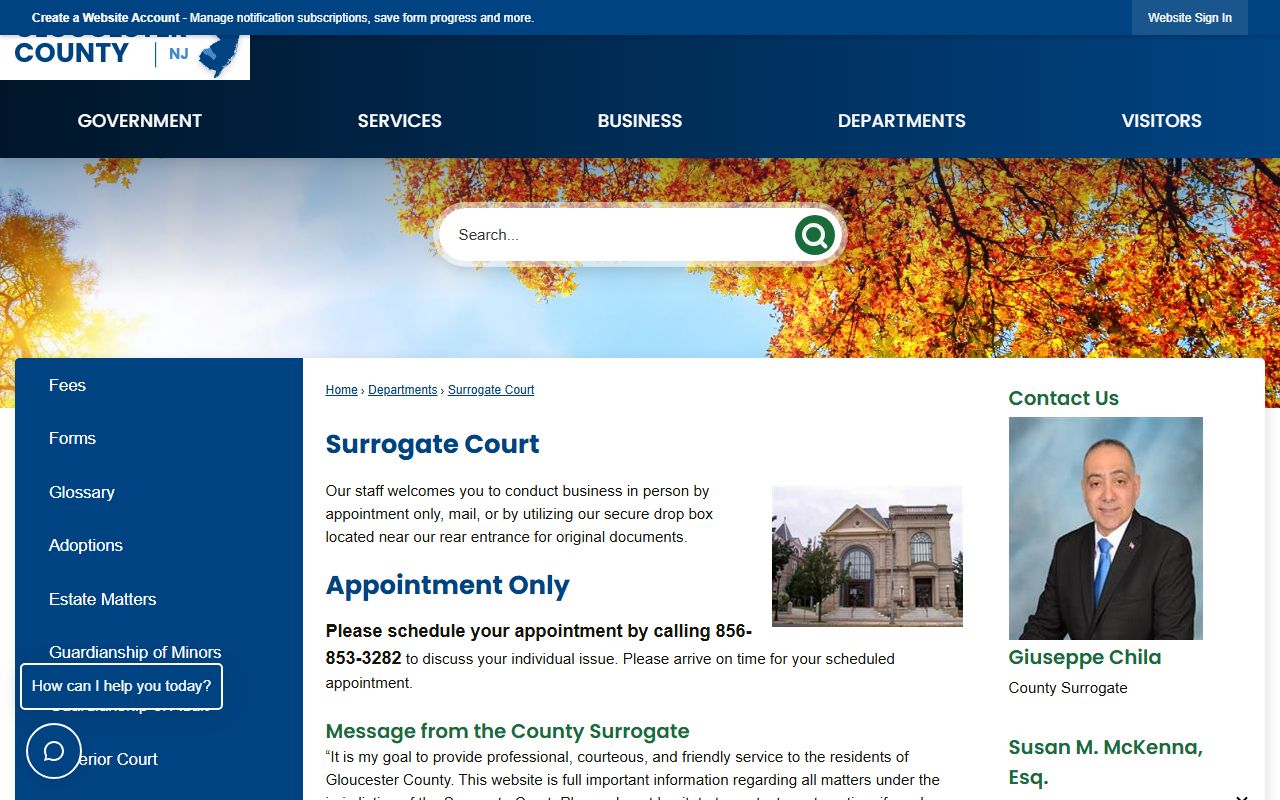
The Surrogate's Court page lists the appointment-only policy, the drop box, and parking near Woodbury High School. Call 856-853-3282 to schedule an appointment and arrive on time.
Gloucester County Surrogate's Court
17 North Broad Street, P.O. Box 177
Woodbury, NJ 08096
856-853-3282
Document searches: 856-853-3286
What Gloucester County Probate Covers
Probate is the legal process that establishes a will is genuine and appoints someone to administer the estate. A will is probated after death when the decedent held assets in their name alone. The estate is opened in the county where the decedent resided, as shown on the death certificate. The Surrogate makes the final judgment on a will's validity in uncontested probate. So a Gloucester resident's estate is opened with the Gloucester Surrogate, even if assets sit elsewhere.
The Surrogate's role reaches beyond wills. It supervises minors' trust funds, serves as clerk for adoptions, and handles adult guardianship filings. For contested matters, jurisdiction shifts to the Superior Court, which is covered further below.
The Surrogate is also a constitutional officer, elected for a five-year term. The Surrogate is both the Judge of the Surrogate Court and the Deputy Clerk of the Superior Court Probate Part. That dual role is why the same office can grant an uncontested probate and also serve as the filing clerk when a probate dispute heads to the Superior Court. Wills are not registered before death; the original will is filed only when it is admitted to probate.
The Estate Probate Process
The process follows a set order. A key timing rule is that the Surrogate cannot issue a short certificate until the eleventh day after death, even though a will may be offered any time after death. The steps below outline a typical uncontested probate.
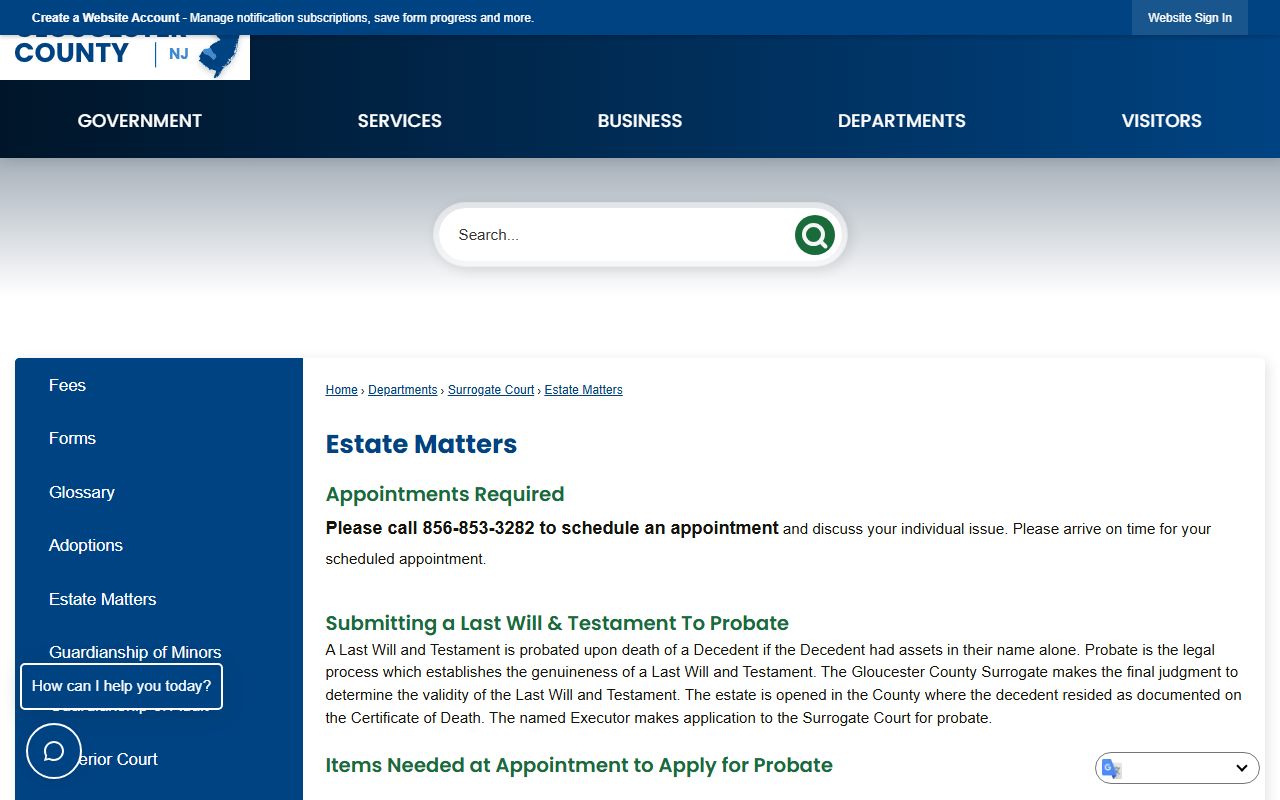
The Estate Matters page lists the probate requirements and the probate fee. The general path runs as follows.
- The named executor schedules a probate appointment with the Surrogate.
- The executor brings the original will, the death certificate, and the required items.
- The Surrogate reviews the will and, after the eleventh day, can act.
- If accepted, the executor is appointed to administer the estate.
- The Surrogate issues short certificates that prove the executor's authority.
What to Bring to a Probate Appointment
Coming prepared keeps the appointment short. The Surrogate lists the items needed to probate a will. Missing the original will or the raised-seal death certificate can stop the process, so gather everything first.
- Original Last Will and Testament, plus any codicils.
- Original death certificate with a raised seal.
- Government identification.
- Addresses of all named beneficiaries.
- Names and addresses of immediate next of kin.
- A list and value of assets in the decedent's name alone.
- Form of payment for the fee.
The asset list helps the Surrogate decide how many short certificates the estate needs. Bringing the form of payment and government identification also keeps the appointment moving, since the Surrogate confirms identity before acting on an estate.
Probate Fees in Gloucester County
The basic probate fee is set by the Surrogate. It covers a short two-page will and one short certificate, with a small charge for extra pages. The table shows the core probate fee.
| Item | Fee |
|---|---|
| Probate, two-page will (includes one short certificate) | $100 |
| Each additional will page | $5 |
| Additional short certificates | Per Surrogate fee schedule |
Additional costs can apply for extra short certificates or related filings, so ask the Surrogate for the current fee schedule. Plan for the form of payment the office accepts, which is confirmed at the appointment.
Short Certificates and Estate Authority
A short certificate is the document that proves an executor's or administrator's authority to act. Banks, courts, and other institutions ask for one before they release estate assets. The Surrogate issues short certificates once the executor is appointed, and the number an estate needs depends on its assets.
Because each institution may want its own certificate, estates often request several. The Surrogate cannot issue one until the eleventh day after death, which is why probate timing starts there. The asset list an executor brings to the appointment drives how many certificates the Surrogate prints, so a careful inventory up front saves a return trip.
Intestate Estates Without a Will
When a person dies without a valid will, the estate is intestate. The Surrogate then appoints an administrator instead of an executor. The surviving spouse has the first right to apply. If heirs of equal or closer degree also seek the role, the others must renounce.
In most intestate cases, a surety bond is required to cover the value of the real and personal estate property. This protects the heirs and creditors while the administrator settles the estate. The bond requirement is one reason an intestate estate can be more involved than one with a clear will, since the administrator must qualify and post security before taking charge.
Note: In most intestate estates, a surety bond is required to cover the value of the real and personal estate property.
Contested Probate in Superior Court
The Surrogate's Court has limited jurisdiction. When a dispute arises, parties must take it to the Superior Court of New Jersey, Chancery Division, Probate Part. Gloucester's Surrogate Superior Court page identifies Hon. Robert G. Malestein, P.J.Ch., at 19 North Broad Street, Courtroom 203, in Woodbury. Actions are commenced by verified complaint and order to show cause under Rules 4:83 and 4:67.
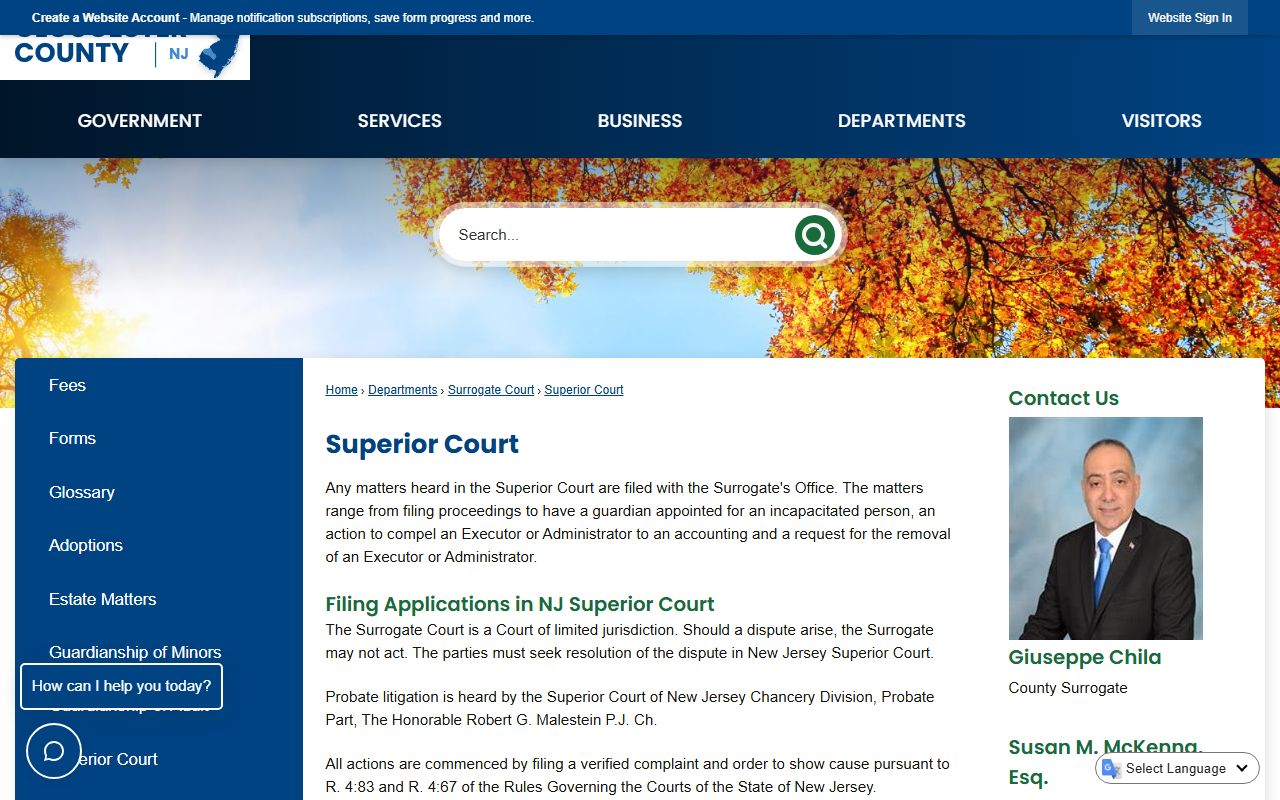
Common disputes include will contests, claims of undue influence, accountings, and guardianship fights. These move out of the Surrogate's limited jurisdiction and into a full court proceeding with a judge. The Superior Court probate page lists the Probate Part filing fees, shown below.
| Filing | Fee |
|---|---|
| Complaint and Order to Show Cause | $175 |
| Answer | $110 |
| Guardianship for Alleged Incapacitated Person | $200 |
| Notice of Motion | $15 |
Document Search Appointments
The Surrogate does not offer an online probate database. Public document searches are by appointment, scheduled in two-hour intervals. Call 856-853-3286 to set one up, and be ready to follow the Surrogate's public search policy. Bring the estate name, the decedent's name, a file number if known, and an approximate date.
The Surrogate FAQ page answers common questions about probate, wills, administrators, and small estates.
The appointment-only model is a deliberate choice that keeps original wills and estate files secure. Walk-in searches are not offered, so the two-hour appointment block is the way the public reaches these records. For original documents outside an appointment, the secure rear drop box accepts filings. Parking sits behind the building near Woodbury High School, with handicapped spaces near the rear entrance and the closest lot reserved for court staff.
Common Probate Terms
Probate uses words that are not part of everyday speech. A short glossary helps when reading a Surrogate file or a will.
- Testator
- The person who made the will.
- Executor
- The person named in a will to administer the estate.
- Administrator
- The person appointed when there is no valid will or executor.
- Intestate
- Dying without a valid will.
- Guardian
- A person appointed to make decisions for a minor or an incapacitated adult.
- Short certificate
- Surrogate-issued proof of an executor's or administrator's authority.