
How to Check for a Gloucester County Warrant
Gloucester County does not run a public online warrant lookup. The Sheriff's Office Warrants Unit maintains the active files, but the official page does not publish a searchable list of names. That means there is no safe one-click way to confirm a warrant from a county website. To check a warrant, you work through official channels.
The safest path depends on the warrant source. A Superior Court warrant routes through the court or an attorney. A municipal warrant routes through the issuing municipal court. The Sheriff's Office can confirm how to handle a county warrant. If you think you may have a warrant, it is usually wise to speak with a lawyer first so you can plan a safe surrender or resolution rather than risk a sudden arrest.
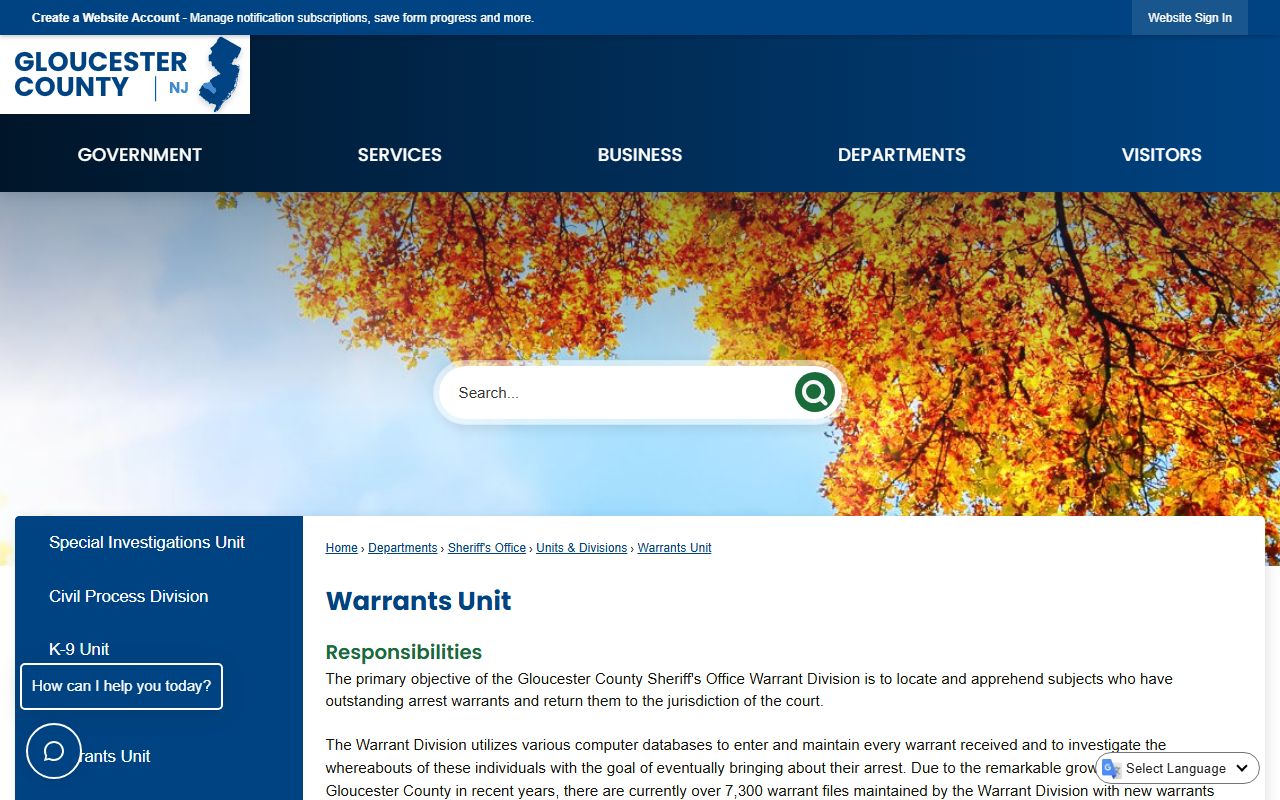
The Sheriff's Office Warrants Unit page describes the division's work and its warrant categories, even though it does not host a public search form.
The Gloucester County Sheriff's Warrants Unit
The Warrants Unit sits inside the Sheriff's Field Services Bureau. Its main job is to locate and apprehend people with outstanding arrest warrants and return them to the court's jurisdiction. The unit enters and tracks every warrant it receives in computer databases and investigates where subjects may be. Gloucester says the division maintains more than 7,300 warrant files, with new warrants arriving every day.
The unit also handles several other duties beyond serving warrants. It supports the broader work of the Sheriff's Office and partners with outside agencies on harder cases. The list below reflects the duties named on the official page.
- Background investigations for new Sheriff's Office hires.
- Fugitive raids with local and state law-enforcement agencies.
- Participation in the U.S. Marshals Service Regional Fugitive Task Force.
- Extradition coordination and transport for the Sheriff and the Prosecutor.
- Juvenile fingerprinting for parent identification kits.
The Sheriff's Office, led by Sheriff Carmel Morina, is based at 70 Hunter Street, Woodbury, and lists a total staff of 113 across its bureaus. The Warrants Unit is one part of the Field Services Bureau.
Types of Gloucester County Warrants
The Sheriff lists several warrant categories. Each comes from a different court process, but all authorize an arrest. Knowing the type helps you find the right office to resolve it. The list below reflects the official categories named by the Warrants Unit.
- Child support, also called domestic relations warrants.
- Civil contempt warrants.
- Domestic violence warrants.
- Failure to appear for Superior Court.
- Failure to comply with a Superior Court order.
- Fugitive from justice, plus state parole and military desertion warrants.
- Juvenile probation and violation of probation.
A bench warrant is one a judge issues, often after a missed court date. Many Gloucester warrants begin exactly that way, which is why staying current on court dates matters. A failure-to-appear warrant simply means a person did not show up when ordered, and it can attach to anything from a traffic ticket to an indictable charge. A child support warrant comes out of Family Court when support orders are not met. A violation-of-probation warrant follows when someone breaks the terms of court supervision.
Domestic violence warrants and civil contempt warrants carry their own court processes and protections. Because each type traces to a different court, the office that can lift the warrant differs too. The court that issued it is the one that can resolve it.
What a Gloucester County Arrest Warrant Contains
An arrest warrant is a court order. It authorizes police to take a named person into custody and bring them before the court. While Gloucester does not publish warrant records to the public, the underlying court file follows the same structure as other New Jersey court records.
A warrant and its related case entry generally include:
- The name of the person sought and identifying details.
- The issuing court and the judge who signed the order.
- The docket or complaint number tied to the case.
- The charge or the reason, such as failure to appear.
- Any bail amount or conditions set by the court.
- The date the warrant was issued and, later, when it is withdrawn.
When a warrant is resolved, the docket usually shows a warrant withdrawn or recalled entry. That is why court records, not warrant lists, are often the most reliable trail. See the Gloucester County court records page for how case files are searched.
Why There Is No Public Warrant List
Some counties post warrant lists, but Gloucester does not. The official Warrants Unit page describes the division and its volume of files without publishing a name-by-name search. This is common for active warrants, because posting them can interfere with apprehension and raise accuracy concerns. The table shows what the official source does and does not offer.
| Search Feature | Available? | Notes |
|---|---|---|
| Public active warrant search | No | No official Gloucester public warrant search form located. |
| Name search | No | Not published on the Warrants Unit page. |
| Warrant type filter | No | Not published on the Warrants Unit page. |
| Sample warrant listing | No | No public sample warrant record is posted. |
Because of this, treat any third-party site claiming a live Gloucester warrant list with caution. Those sites are not official and are often wrong.
How to Resolve an Outstanding Warrant
Handling a warrant the right way protects your safety and your case. Do not rely on people-search or warrant aggregator sites. Work through the court, an attorney, or the Sheriff to confirm the warrant and arrange a safe resolution.
- Do not ignore the warrant; delay usually makes things worse.
- For a Superior Court warrant, contact an attorney, the court, or the Sheriff for surrender instructions.
- For a municipal warrant, contact the issuing municipal court and use NJMCDirect to find ticket or complaint details.
- For a probation or parole warrant, contact counsel or the supervising agency.
- For an out-of-state or fugitive warrant, expect extradition processing.
If you are unsure which court issued the warrant, an attorney or the Sheriff's Office can help you trace it. Many municipal matters can be checked through the traffic court records tools.
Ignoring a warrant carries real costs. A failure-to-appear warrant can lead to a new arrest at a traffic stop, added fees, a license suspension, or bail being set. A child support warrant can hold until the underlying issue is addressed in Family Court. Acting early, with the right help, almost always leads to a better result than waiting for an arrest. People who cannot afford a lawyer may qualify for the Public Defender on eligible criminal matters.
Extradition and Fugitive Warrants
When a subject is found outside New Jersey, the Warrants Unit coordinates the legal documentation and transport to bring the person back. It handles extradition for both the Sheriff's Office and the Prosecutor's Office under a mutual agreement. Fugitive cases may also involve the U.S. Marshals Regional Fugitive Task Force, in which the unit takes part.
Extradition can take time and involves courts in two states. A person held in another state on a Gloucester warrant may wait for paperwork and transport. The Prosecutor's Office is the county's lead criminal agency and a key contact for serious warrant and fugitive matters.
You can reach the office through the Prosecutor's Office contact page for questions about active prosecutions tied to a warrant.
Sheriff Payment Scam Warning
Scammers sometimes impersonate Sheriff's officers and demand payment to clear a supposed warrant. Gloucester County issued a November 20, 2025 alert about this. Scammers may use real names or ranks and ask for gift cards, wire transfers, mobile apps, or banking details.
Important: The Sheriff's Office will never call to demand payment for a warrant, fine, or bail. Verify any such call directly at 856-384-4600.
Real warrant matters move through formal court and law-enforcement channels, never through a phone demand for instant payment. Officers do not request gift cards or wire transfers, and official notices come through formal channels. When in doubt, hang up and call the Sheriff's Office yourself at the published number. Do not give bank or card details to anyone who calls about a warrant.